Today I was introduced to the basics of Hokkien. My main takeaway was that words rhyme with different meanings. For example, three (sa) is similar to shirt and five (gor) is similar to trousers (kor). I also learnt basic noun words like fridge (sheng du). My impression is that Hokkien is a very colourful language and am looking forward to string sentences together.
Assignment 2
Course Reflection
This reflection is based on the module DMA1401CLS Hokkien which consists of Lecture 1 to Lecture 11.
In the first lesson, I was introduced to the basics of Hokkien. My main takeaway was that words rhyme with different meanings. For example, three (sa) is similar to shirt and five (gor) is similar to trousers (kor). I also learnt basic noun words like fridge (sheng du). My impression is that Hokkien is a very colourful language and am looking forward to string sentences together.
In Lecture 2, based on the ‘Are u a Hokkien 2’ video, I learnt a few Hokkien phrases regarding certain food items. Zap cai represents mixed vegetable and can also be used to describe vegetable curry which is Nyonya dish. Or cuk bi represents black glutinous rice. I also learnt to say a rhyming sentence in Hokkien ‘Wa wu sa niah sa’ which means I have 3 shirts. Even though tau ka chiu literally means take out your hand and leg, it has an inferred meaning when used which is to help out. A certain phrase may be said differently by some based on one’s culture and background.
Touching on lecture 3, certain phrases are expressed in a unique way in Singapore Hokkien compared to other kinds of Hokkien. For example, market in Singapore Hokkien is expressed as pasat which is similar to a local Malay term as compared to cai qi ah. In asking the stall owner what time he starts business, I learnt how to use this question and answer with different timings, using numbers I have learnt in the first lesson. The question ‘Ah pek kway tiam kai xi’ can be replied with ‘si diam’ or ‘gor diam’ for instance. The phrase ‘Lang zi hui tou’ actually has the meaning of turning back which can imply turning over a new leaf
In Lecture 4, we learnt about different animals and food in Hokkien. We can simply ask how much food one is going to eat by saying ‘li eh sai jia kway bao’ which directly translates to how many packets you want to eat. The youtuber introduced ‘si ka zua’ as lizard however we learnt that this term is actually monitor lizard while lizard is actually ‘ji leng’ which stands for a kind of dragon. I did not expect that some of the Hokkien words for the animals sound similar to their actual sounds they emit. For example, ‘gu’ for cow sounds like its moo sound.
Learning was done based on the lyrics from ‘Long Liu Lian’ for lecture 5, otherwise translated as Waves Wandering. Some of my direct takeaways from the song is the 成语 ‘hong hong u u’ which directly translates to windy and rainy, also a description for something faced with many obstacles. The title of the song is mentioned in the line ‘lan long si ui tio ai jiong lai long liu lian’, which directly translates to wandering on waves for love. However, the implied meaning I have taken away from that line is going through ups and downs for love, using waves as a symbolic idea in Hokkien adds a layer of beauty and emotion to the song. Incidentally, the words we’ve learnt previously like ‘siau lian’ and ‘jit eh’ are present in the song, which means youngsters and the number one paired with a classifier.
Week 6 was the week of assignment 1, as seen from the video in a previous post. This picture below is a screenshot of myself singing in the video.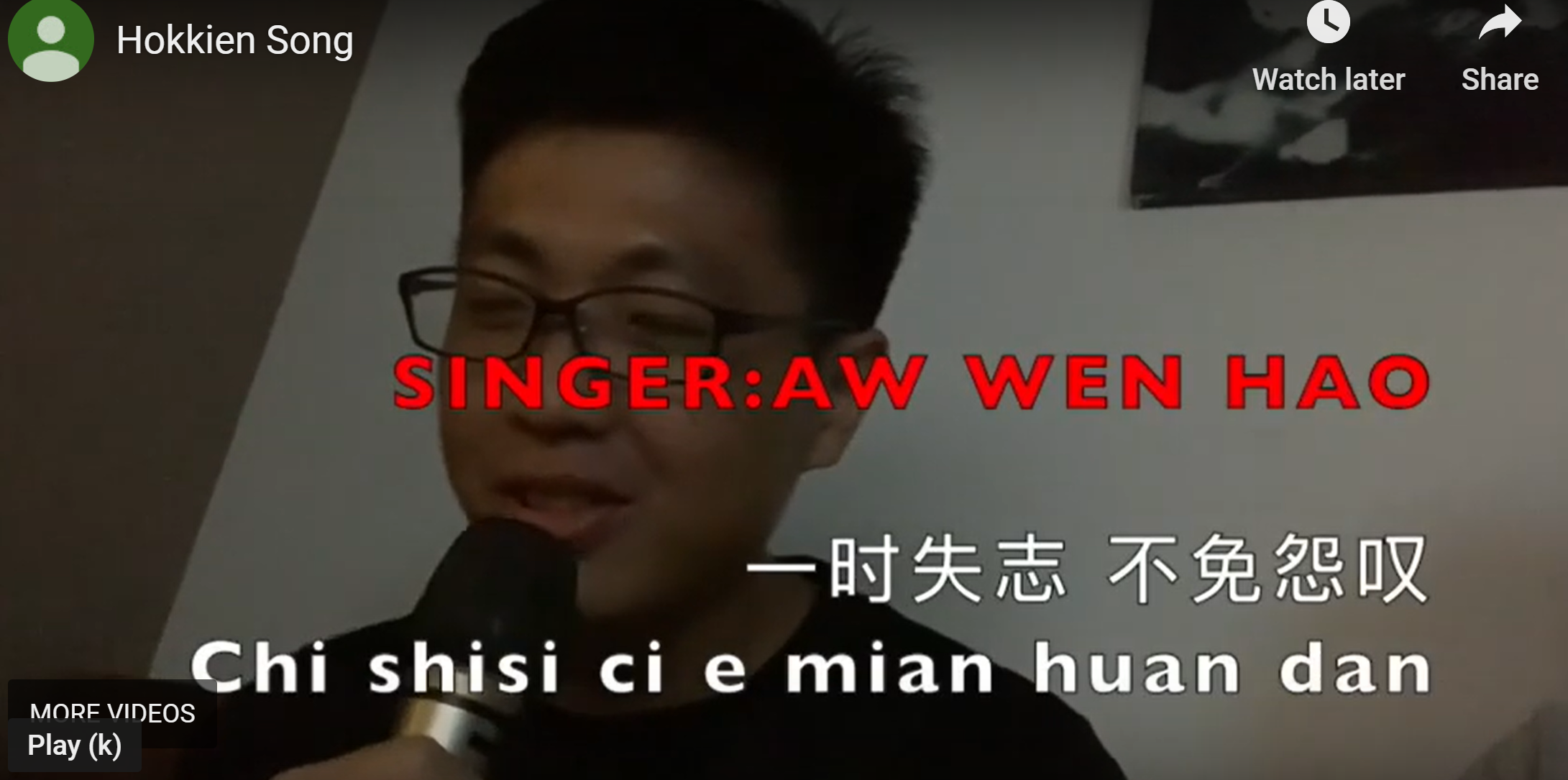 https://hokkien.tech.blog/2020/03/03/assignment-1/
Lecture 7 consisted of a mp3 recording for our learning. I have learnt that the direct translation of ‘chu geh’ is chu jia in Chinese, which literally means leaving the house. Moreover, I gained extended knowledge about this phrase as it can also mean to marry, which can be implied if a spouse moves out of her house. The unexpected realisation that I got was that ‘bak kut teh’ is actually a popular Hokkien dish, given by the fact that a lot of Hokkien ‘gu li’, known as coolies, patronise the pork rib stall mentioned in the audio.
Lecture 8’s learning material was a skit portraying a conversation between an elderly lady and a fortune teller. I learnt important keywords about healthcare which were mentioned in the conversation. The lady ‘kua sa eh lou kun’ meaning she saw 3 doctors. The fortune teller is informing about her being covered by ‘bo hiam’ which refers to medical insurance in the skit’s context. For assignment’s 2 skit, I think we can indirectly refer to this skit as an example of how to have a conversation using emotive words. For example, the lady expresses discontent about her medical bill in the form of ‘ Singapore eh min kia ah ni gui’. Given the current covid-19 situation, we can learn from this skit that medical insurance ‘bo hiam’ is important to pay the bills as ‘geng kong eh si zai’.
A video titled related to ‘zong xin gin bo’ is lecture 9’s material, which translates to Medishield Life, an insurance policy concerning people in Singapore. The pioneer generation has benefits with a card known as ‘PG ka’ which I did not existed, so that ‘fei yong ji shi heng dan bo’ meaning only a small portion of medical fees have to be forked out from one’s pocket. The hokkien song ‘dui dui dui’ uses repeated words ‘dui’ and ‘huan’ to emphasise meaning and I discovered a useful to described a woman’s heart in the phrase ‘nu lin e sim tau hu tsue e’ which means a woman’s heart is made of toufu.
I learnt a proverb in Lecture 10 which is pronounced in Hokkien ‘li niu lang wu bou, jiu si hou ka ki wu lou’. The meaning behind this proverb is to let others take their turn so that a path will be created for yourself. The catchy electronic song ‘Lian wu gong’ by Jeannie hsieh made me realise that the phrase ‘lian wu gong’ which means train martial arts has similar pronunciation in Hokkien and Chinese. Moreover, the song describes youth and a skirt as being ‘teh teh’ which means short. This shows the ability of Hokkien adjectives to describe different kinds of things in a song to bring out repetition across lines of verses.
Last but not least, in lecture 11, another proverb ‘Li shi lang wu jing yi ji shi lang zuo kia di’ was learnt. It means that our current friends are the result of relationships in the past life. Living in today’s pandemic, we have to constantly remind of ourselves to take precautions. The Hokkien sentences regarding these precautions can be used in our skit. For example, ‘Na si li eh lang bo hou, siong hou si mai cu ke, nai si bo ban huan ai cu ke, li ai cheng mask’. We should not go out and infect others when we are not feeling well, and if we have no choice but go out, we must wear a mask. Most importantly, in today’s digital age, fake news is prevalent and we must be careful not to be misleaded by it. This is aptly described by the sentence in Singapore’s context: ‘Ji gun, jin zui lang su ka dua lang dua lang kong wei,lang luan luan kong wei li mai luan luan xiong xin, li ai tam seng wun, li ai ki ka http://www.moh.gov.sg’.
Ultimately, this module has helped me expand my Hokkien vocabulary and helped me understand some of my Hokkien-speaking family members better. However, if I want to further improve my speaking skills, I would have to converse with them more often if not the vocabulary learnt will soon be forgotten.
31/3/2020 Reflection
Another proverb ‘Li shi lang wu jing yi ji shi lang zuo kia di’ was learnt. It means that our current friends are the result of relationships in the past life. Living in today’s pandemic, we have to constantly remind of ourselves to take precautions which are mentioned in our skit. For example, ‘Na si li eh lang bo hou, siong hou si mai cu ke, nai si bo ban huan ai cu ke, li ai cheng mask’. We should not go out and infect others when we are not feeling well, and if we have no choice but go out, we must wear a mask. Most importantly, in today’s digital age, fake news is prevalent and we must be careful not to be misleaded by it. This is aptly described by the sentence in Singapore’s context: ‘Ji gun, jin zui lang su ka dua lang dua lang kong wei,lang luan luan kong wei li mai luan luan xiong xin, li ai tam seng wun, li ai ki ka http://www.moh.gov.sg’.
24/3/2020 Reflection
This week, I learnt a proverb which is pronounced in Hokkien ‘li niu lang wu bou, jiu si hou ka ki wu lou’. The meaning behind this proverb is to let others take their turn so that a path will be created for yourself. The catchy electronic song ‘Lian wu gong’ by Jeannie hsieh made me realise that the phrase ‘lian wu gong’ which means train martial arts has similar pronunciation in Hokkien and Chinese. Moreover, the song describes youth and a skirt as being ‘teh teh’ which means short. This shows the ability of Hokkien adjectives to describe different kinds of things in a song to bring out repetition across lines of verses.
17/3/2020 Reflection
This week’s is related to a video titled related to ‘zong xin gin bo’, which I learnt to Medishield Life, an insurance policy concerning people in Singapore. The pioneer generation has benefits with a card known as ‘PG ka’ which I did not existed, so that ‘fei yong ji shi heng dan bo’ meaning only a small portion of medical fees have to be forked out from one’s pocket. The hokkien song ‘dui dui dui’ uses repeated words ‘dui’ and ‘huan’ to emphasise meaning and I discovered a useful to described a woman’s heart in the phrase ‘nu lin e sim tau hu tsue e’ which means a woman’s heart is made of toufu.
10/3/2020 Reflection
This week’s learning material was a skit portraying a conversation between an elderly lady and a fortune teller. I learnt important keywords about healthcare which were mentioned in the conversation. The lady ‘kua sa eh lou kun’ meaning she saw 3 doctors. The fortune teller is informing about her being covered by ‘bo hiam’ which refers to medical insurance in the skit’s context. For assignment’s 2 skit, I think we can indirectly refer to this skit as an example of how to have a conversation using emotive words. For example, the lady expresses discontent about her medical bill in the form of ‘ Singapore eh min kia ah ni gui’. Given the current covid-19 situation, we can learn from this skit that medical insurance ‘bo hiam’ is important to pay the bills as ‘geng kong eh si zai’.
 Hokkien Reflections